For many travel brands, social media is another marketing channel. At Mad Monkey, it underpins a demand-generation strategy built around how hostelers travel.
The hostel operator's core audience—primarily young travelers taking gap years or extended trips through Southeast Asia—is unlikely to return year after year. Rather than measuring success through long-term repeat stays, Mad Monkey aims to capture as much of that journey as possible while encouraging guests to introduce the brand to the next generation of travelers.
“Our audience is transient,” said Lexie Hadley, head of marketing at Mad Monkey. “It could be a two-week trip, it could be a year-long trip, even just within the realms of Southeast Asia, and it doesn’t tend to happen again.”
That reality has shaped nearly every aspect of the company's social strategy, from how it works with creators to how it has redesigned loyalty.
“How much can we keep them in the ecosystem for that potentially short period of time?” Hadley said.
Building a creator ecosystem
Mad Monkey decided to manage social internally after finding agency partners struggled to capture the brand and its 25 properties, Hadley said.
“I think it’s just one of those things that has been a struggle for us, and I think a lot of other people really are just trying to nail down what works, and I think it changes all the time,” Hadley said.
The company has hostels in markets including Cambodia, Indonesia, the Philippines and Thailand and targets travelers aged 18-25, primarily those from the U.K., Europe, the United States and Australia.
Since bringing the program in-house, Mad Monkey has devised a multipronged approach that has enabled the brand to grow its social media presence to 60,000 Instagram followers and a monthly organic reach of 5 million people. It reached this milestone by creating multiple avenues for travelers and creators to share their Mad Monkey experiences—all while encouraging others to share and book.
One of those initiatives is the Creator Hub, a platform that gives creators a structured way to collaborate with the company. Rather than relying solely on one-off outreach, creators can apply to work with Mad Monkey, exchange complimentary stays for content and receive personalized booking codes that give their audiences discounts while earning commissions on direct bookings.
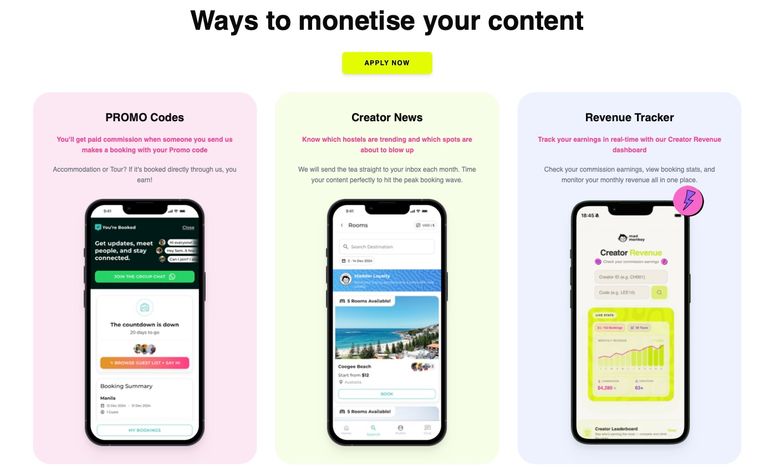
Photo Credit: Mad Monkey
Mad Monkey Creator Hub
The platform streamlines what can otherwise be a time-consuming process while helping Mad Monkey continuously generate authentic content across Instagram and TikTok. The company currently has more than 200 active creator codes, works with roughly 30 creators each month and hopes to increase that to 50, Hadley told PhocusWire.
The Creator Hub provides an entry point for content creators to engage with Mad Monkey, an approach that feeds into the brand’s broader strategy. Once creators join the platform, some go on to host group trips through the brand’s Takeovers program.
From influencer takeovers to group trips
“Takeovers was born at the beginning of this year,” Hadley said. “It gets people talking, basically gets people booked on the trip.”
Through Mad Monkey’s Takeovers initiative, creators invite followers to join them on scheduled itineraries centered around the hostels. Each trip has its own landing page outlining the route, pricing and booking details, making it easy for creators to direct their audiences to a shared travel experience.
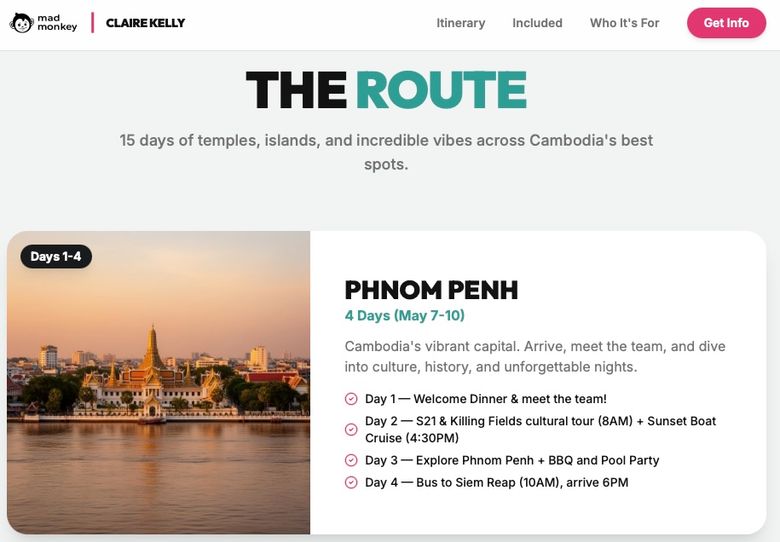
Photo Credit: Mad Monkey
Mad Monkey Takeover Landing Page
Creators receive complimentary travel while earning commissions tied to bookings.
“Most of the people that pay for the trip with the influencer, they’ve followed the influencer for months, years maybe,” said Hadley. “So it’s like, ‘I followed this person for a reason, and I’ve paid this money because I would like to meet them, or their vibe is very aligned with me.’”
According to Marina Petrova, CEO and co-founder of Intentful, social media is key to building trust with young travelers.
“For the younger generation, who are social media natives, social is where trust lives for them,” Petrova said. “Mad Monkey is building on that trust and found a way to make it as native to the experience as social media is to their target audiences.”
As the Takeover program gained traction, Mad Monkey identified another opportunity. Rather than relying exclusively on creators to host those experiences, it decided to launch its own branded group trips, targeting those who have already engaged with the company through previous stays, Takeovers or social media.
“People that are taking a Takeover, perhaps their next adventure could be our group trip,” Hadley said.
The first group itinerary, launching in Indonesia, is designed to build on the same sense of shared discovery while allowing Mad Monkey to deepen relationships with travelers already familiar with the brand.
Choosing small creators over big influencers
Running multiple creator programs has also changed how Mad Monkey evaluates partnerships.
“We don't care how many followers you have,” Hadley said. “You can have 5,000 followers or less; it does not matter to us. We're looking for people that have a good engagement rate ... they love the brand, and they want people to experience more of it.”
Petrova believes authenticity has become increasingly valuable as social feeds fill with sponsored content.

We are wired to sense inauthentic immediately, so our minds trigger trust to authenticity and human connection...
Marina Petrova, Intentful
“There is often such a stark difference between genuinely created content by people and the one that likely went through 10 rounds of ‘move-this-pixel' editing and approvals,” Petrova said.
“We are wired to sense inauthentic immediately, so our minds trigger trust to authenticity and human connection more than to what feels like a manufactured message.”
Instead of paying large upfront sponsorship fees, Mad Monkey increasingly rewards creators based on performance.
“If an influencer says, ‘I want you to pay me $1,000 for this thing to happen,’ it flops because they don't really care,” Hadley said.
“The hungrier ones are the smaller accounts.”
With the growth of social media, it became clear that authenticity breeds trust, “simply because of how people are wired,” said Petrova. “Mad Monkey seems to be bringing it all together in an exceptional way—they merged reach, frequency, authenticity, brand building and made it not just their distribution and marketing strategy, but it is the foundation of the business itself.”
A new kind of loyalty
Mad Monkey's strategy doesn't end once a traveler makes a booking.
Recognizing that many guests spend weeks or months traveling through Southeast Asia, the company redesigned its loyalty program to help travelers stay connected throughout that journey. Rather than measuring loyalty by whether travelers return years later, Mad Monkey focuses on keeping them within its network as they move from one destination to the next.
Members can link their Instagram accounts, join property-specific group chats, connect with fellow guests and participate in leaderboards based on countries visited and nights stayed.
Recognizing that many travelers initially find them through Hostelworld, the program gives guests credit for stays booked via the online travel agency while encouraging them to book direct for future stays, Hadley said.
Creator partnerships, Takeovers, group trips and loyalty are not standalone initiatives. Together, they reflect a strategy designed around the way its guests discover destinations, experience travel and ultimately encourage others to follow in their footsteps.
Petrova believes that blending marketing, community and the guest experience reflects a broader shift among younger travelers.
“Humans always need to be a part of the community, but increasingly, the community may live in a WhatsApp group or elsewhere online,” she said.
“That community layer is a part of the experience itself, so the marketing and the experience become so blended they are almost the same thing. Brands that understand it and can build it authentically, win.”